President Trump's recent comments marked another effort to shift public perception on a conflict he previously described as yielding swift and conclusive results.
In a recent statement, President Trump downplayed the significance of potential conflict with Iran, claiming the economic implications would be minimal despite the ongoing war.
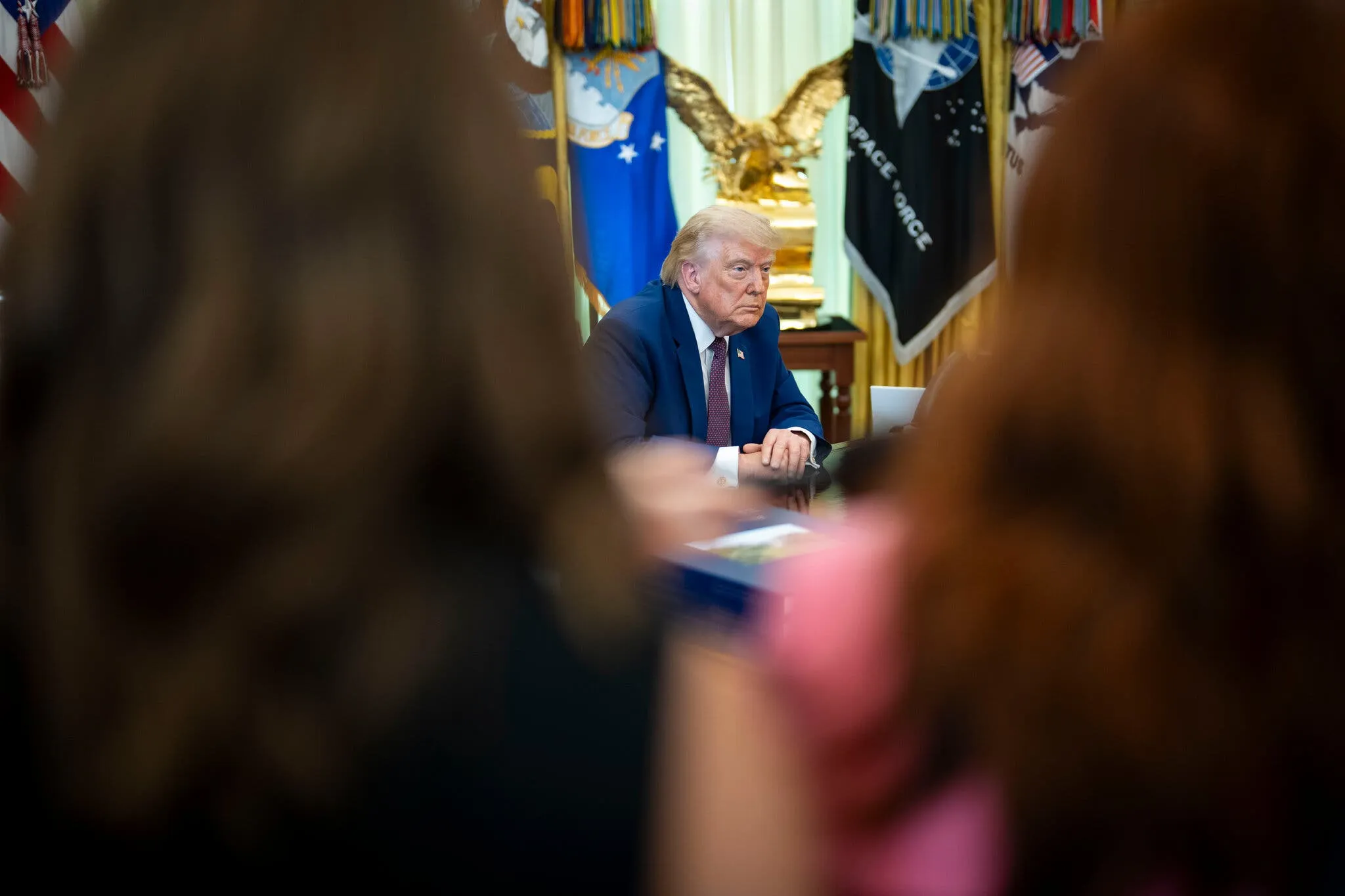
Related ↗Soldier under investigation for fatal shooting by Israeli military police.In the Oval Office, Mr. Trump addressed journalists, stating that the ongoing conflict with Iran had so far yielded more positive results than anticipated. The president expressed pride in his administration's handling of the situation, referring to it as an "unplanned excursion" into Iranian territory. At least 13 U.S. service members and approximately 1,700 civilians have lost their lives.
The US President seems to downplay the potential consequences of conflict with Iran by comparing them to historical market highs. He emphasizes America's strong military capabilities, implying that war or military action would be manageable.
Read next ↗President Trump vows to urge restraint from Israel in response to Iranian retaliation.President Trump made assertions about declining costs for consumers, pointing to purported assurances from "financial experts" that the surge in 401(k) values was translating into substantial earnings.
President Trump's latest assertion claims a swift resolution is possible if the US participates in a joint operation with Israel, as seen on February 28th. However the prolonged duration of the conflict now exceeds three months, leaving its outcome uncertain and far from decisive.
The elusiveness of US objectives in the region has led to a shift in President Trump's stance on the conflict's unpopularity, now downplayed despite its impact on American wallets at fuel stations and supermarkets nationwide.
In recent weeks, President Trump has made it clear that economic considerations play no role in his decision-making regarding the conflict with Iran. His latest social media statement, posted at 1 a.m., targeted lawmakers who he believes are overly vocal on the issue of war.
The president's message conveyed a sense of optimism about the situation unfolding.
Recently, the President's comments have suggested a potential breakthrough in US-Iran relations, with a framework for peace seemingly within reach. His announcement last week that he would convene an urgent meeting in the Situation Room sparked speculation about a pending agreement.
A decision on that matter has yet to be reached.
On Monday, the president expressed his sentiment about the talks with Iranian leaders as "extremely dull".
President Trump has repeatedly set deadlines for Iran to agree on a peace treaty, stipulating that any accord must guarantee their nuclear disarmament. His comments on the negotiation status have been inconsistent and unclear so far.
Mr. Trump's statement on removing Iran's enriched uranium stockpile last week has sparked concern about potential conflict consequences. He claims Iran accepted the condition, downplaying its significance by labeling the operation "overhyped" in his assessment of the situation so far.
The president downplayed the significance of a potential conflict, suggesting its importance varies greatly among individuals.
Mr. Trump noted that Iran initially accepted certain terms, such as forgoing nuclear development, but then reversed course on those commitments.
The President emphasized the need to prevent Iran from acquiring a nuclear capability, citing past agreements as evidence of successful diplomacy.
The president clarified that by signing the agreement, Iran would be committing to forgo all forms of nuclear development and acquisition.
The president emphasized that past talks centered on acquiring a nuclear capability versus creating one from scratch. He noted that ultimately, this distinction was acknowledged by all parties involved, pending signature of an agreement.
A draft agreement is almost finalized, according to the President's comments. The administration has had surprisingly good relations with Iran so far.
Mr. Trump's stance on next steps remained ambiguous, reflecting his earlier oscillation between issuing ultimatums and adopting a wait-and-see approach with Iran. The US military, meanwhile, appeared poised to endure a prolonged engagement.
The president acknowledged a potential for devastating consequences within two to three weeks of escalating conflict with Iran. He expressed reluctance to pursue this path, deeming it straightforward but ultimately undesirable. The Iranian side appears eager to engage in hostilities, making a written agreement a preferable alternative to widespread destruction.