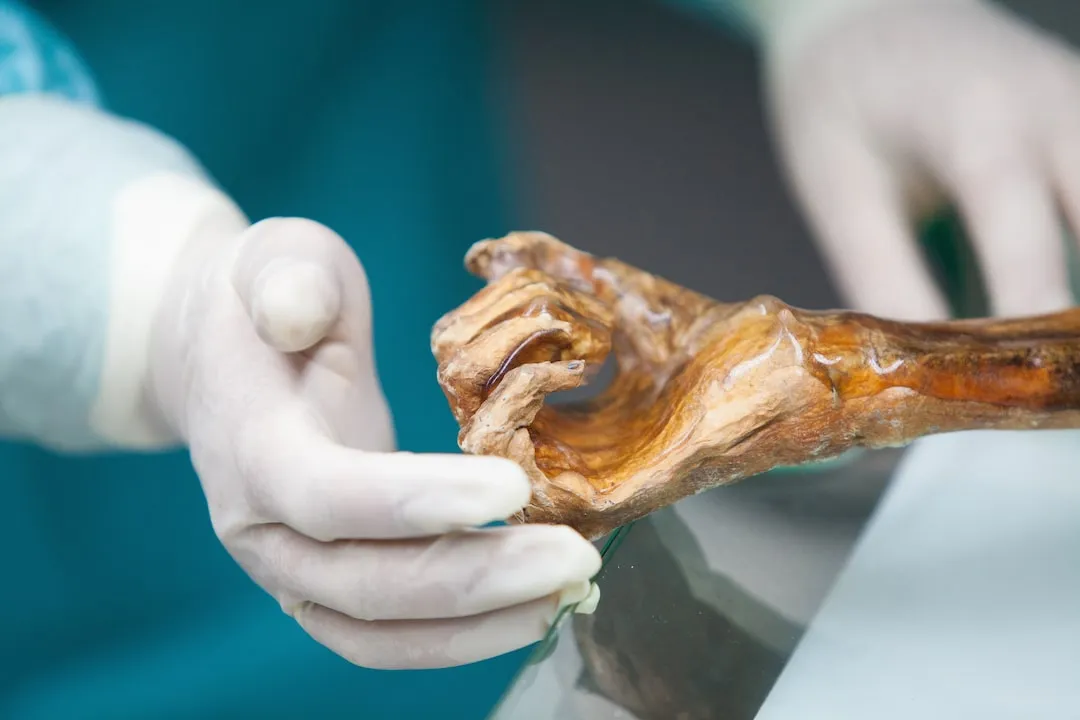
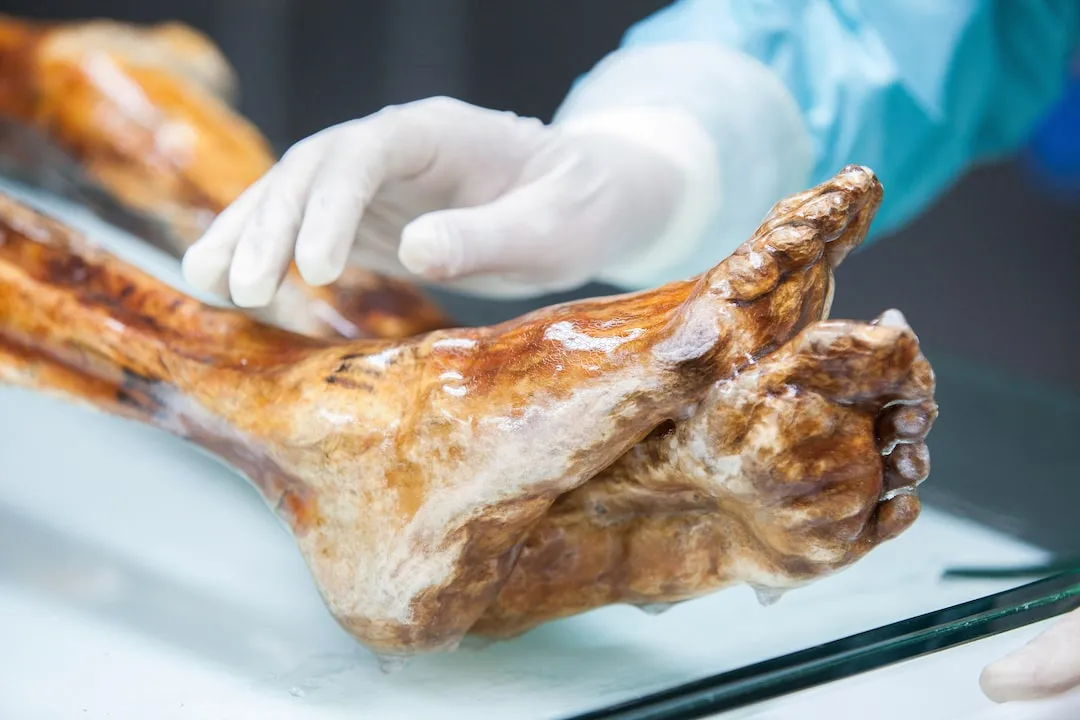
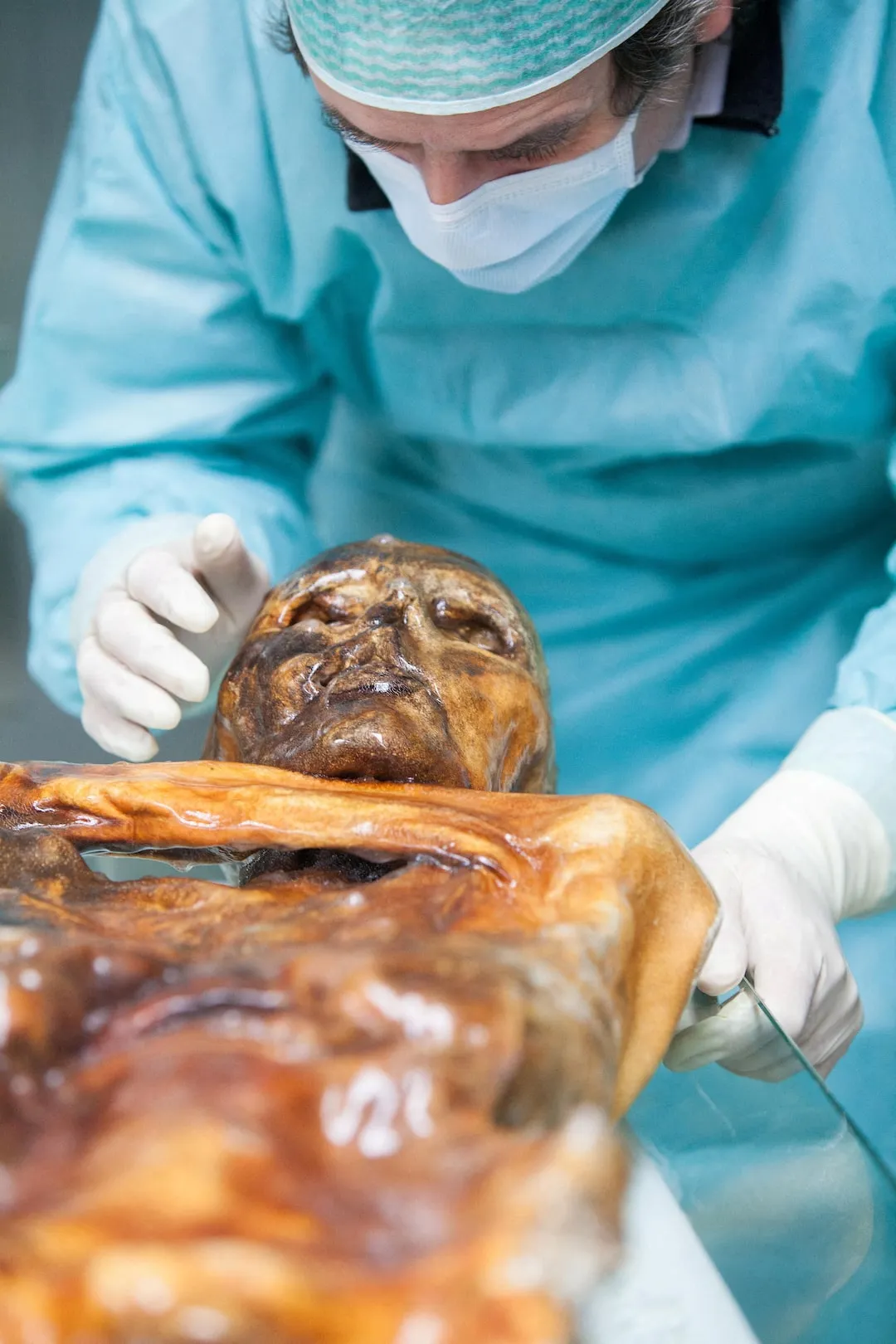
Europe's oldest-known natural mummy, Ötzi, has been a remarkably well-preserved specimen for 5,300 years.
Ötzi the Iceman met a violent end approximately 5,300 years ago on the modern border between Italy and Austria's Alpine region. A lethal arrowhead had pierced his left shoulder, leading to fatal bleeding during the assault in mountainous terrain. However Ötzi's legacy lives on due to recent research findings.
Related ↗A powerful earthquake measuring 7.8 magnitude hits the south of Philippines.The microbial ecosystem of Ötzi the Iceman has been extensively studied over a period spanning more than three decades. The analysis revealed a diverse range of bacteria, fungi, and yeasts present across various tissue sites on his body. Discovered in 1991, Ötzi's remarkably preserved remains have provided valuable insights into Europe's oldest-known natural mummy.
Inside Ötzi's body, researchers discovered a trio of distinct microbial realms. These comprised his original gut bacteria, which had thrived within him during life, as well as cold-resistant microorganisms sourced from the glacier environment where he was found, and modern microbes introduced over three decades of museum preservation.
Read next ↗New Obesity Treatment from Boehringer-Zealand Reduces Visceral Liver Fat Effectively.Mohamed Sarhan, lead researcher at Eurac Research's Institute for Mummy Studies in Bolzano, Italy, asserts that Ötzi is a living ecosystem rather than a lifeless relic. This dynamic microbial community was unveiled through their study published recently in the journal Microbiome.
Scientists have discovered thriving microbial communities within Ötzi's body. These microorganisms are not only alive but also actively adapting to their surroundings. Yeasts, specifically those adapted to cold temperatures, are observed to be multiplying. Bacteria have successfully colonized and persisted in Ötzi's tissues for an astonishing 5,000 years. The mummy serves as a unique interface between ancient and modern microbial ecosystems, where organisms from different eras coexist.
The discovery of Ötzi's microbial ecosystem offers a unique glimpse into the digestive system of a Copper Age individual, untouched by modern influences such as industrialization, antibiotics, and processed foods that have altered the natural balance of human microbiomes since ancient times.
The discovery of thriving cold-loving yeasts on Ötzi, preserved at 21 degrees Fahrenheit (-6 degrees Celsius), stored at the South Tyrol Museum of Archaeology in Bolzano, has sparked concerns for the mummy's long-term preservation and its implications for conservation science.
Microbes discovered in Ötzi's intestines from his time period are linked to a diet rich in fiber, unlike those typically consumed by individuals in contemporary Western societies.
Dietary changes, increased antibiotic consumption, and diminished contact with nature are thought to be contributing factors to the decline of certain microbes in Western populations. By studying Ötzi's microbial ecosystem, researchers may uncover clues about what we've lost and how to potentially restore it for better health outcomes.
Some of the ancient microorganisms remained metabolically viable.
Our research sheds light on a pivotal aspect, one that sparks great curiosity.
The gut bacteria's DNA exhibits unmistakable signs of chemical decay accumulated over thousands of years. This suggests their genetic material is indeed ancient and authentic. While we can't conclusively assess metabolic activity from DNA analysis, it's evident that these cells have been remarkably preserved in the intestinal tract's protected anaerobic environment for more than five millennia.
15Microbial secrets revealed.
Research on Ötzi's stomach contents has uncovered the types of food he consumed before his death - specifically deer and goat meat, along with wheat. Studies have estimated that he was around 45 years old when he passed away, which is relatively advanced for someone from his time period. His physical fitness suggests a life of regular activity. He carried an assortment of tools including a copper axe, longbow, arrows, quiver, flint dagger, and backpack, as well as sporting geometric tattoos.
Microbiologist Frank Maixner, director of Eurac's Institute for Mummy Studies, sheds valuable light on historical times through his meticulous research as a study co-author.
Researchers identified the microbes that inhabited Ötzi's body during his lifetime versus those that settled in after his passing. Following death, the icy terrain contributed a distinct microbial population, comprising hardy bacteria and yeasts from the adjacent glacial environment.
Deep tissue microbes exhibiting significant DNA damage likely inhabited Ötzi's body during his lifetime or shortly thereafter, according to expert Sarhan's assessment.
Researchers distinguish between newly introduced microbes with no DNA damage and those found on glaciers, which represent a transitional phase of colonization after death but before discovery, according to Sarhan. The viable and metabolically active microorganisms detected were cold-tolerant yeasts present on Ötzi's skin and in his bodily fluids.
The museum's acquisition of the specimen sparked a surge in microbial growth afterwards.
Conservation efforts have inadvertently altered the mummy's surface microbiome by introducing a prevailing strain of bacteria through the use of spray water, which maintains humidity levels. This unforeseen outcome stems from modern preservation methods, highlighting a previously unacknowledged consequence of these practices.