
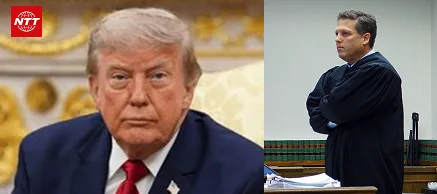
Federal judges named Roger Rogoff US Attorney in Seattle. Trump fired him 54 minutes later. What happened, why it may be unlawful, and what comes next.
Roger Rogoff was a United States Attorney for less than an hour. On July 15, 2026, federal judges in Seattle swore him in as the top federal prosecutor for Western Washington. Fifty-four minutes later, President Donald Trump fired him — a whiplash sequence that has turned an obscure corner of federal law into a national fight over who really controls America's prosecutors.
Related ↗Zendaya and Tom Holland Are Married: Tom Confirms the WeddingThe dispute sits at the intersection of a rarely discussed statute, a three-year leadership vacancy, and a broader clash between federal judges and the Trump Justice Department. Here is what happened, who Rogoff is, why the administration says the firing was lawful, why Rogoff says it was not, and what the case could mean for the balance of power in Washington.
03What Happened: 54 Minutes From Oath to Ouster
On the morning of July 15, 2026, federal judges swore in Roger Rogoff as US Attorney for Western Washington. Fifty-four minutes later, President Trump removed him.
Read next ↗Social Security 2027 COLA Increase: Latest Estimate Is 3.8%The timeline is what makes this story extraordinary. At about 7:40 a.m. on July 15, 2026, the federal judges of the US District Court for the Western District of Washington swore in Roger Rogoff as their choice for United States Attorney. Fifty-four minutes later, the Trump administration notified him electronically that he had been removed from the post. By some accounts, the message reached him while he was still at the courthouse.
The removal notice was blunt. It informed Rogoff that, pursuant to the President's authority, he was being removed from the office of United States Attorney. In under an hour, a career prosecutor went from taking the oath for one of the most important law-enforcement jobs in the Pacific Northwest to being told he no longer held it.
The clash was not really about Rogoff the person. It was about a deeper question that has been building for more than a year: when a US Attorney post sits vacant without a Senate-confirmed appointee, who gets to fill it — the President, or the courts?
08Who Is Roger Rogoff?
Rogoff is a veteran prosecutor and jurist: a former federal Assistant US Attorney, a former King County Superior Court judge, and the former director of Washington's Office of Independent Investigations.
Roger Rogoff is not a political newcomer or an unknown quantity. He spent years as an Assistant United States Attorney, the kind of line prosecutor who actually tries federal cases, before moving to the state bench as a King County Superior Court judge. That combination — prosecuting for the federal government and then judging from the other side of the courtroom — gave him a rare, well-rounded view of the justice system.
More recently, Rogoff served as the first director of Washington's Office of Independent Investigations, a body created to independently investigate police use of deadly force. Running that office required exactly the qualities you want in a top prosecutor: independence, credibility with both law enforcement and the public, and a willingness to follow facts wherever they lead. That resume is a large part of why 17 federal judges were comfortable handing him the office.
12The Section 546 Mechanism: How Judges Can Appoint a Prosecutor
Under 28 U.S.C. § 546, the Attorney General can name an interim US Attorney for 120 days. If that window closes with no Senate-confirmed appointee, the district court judges may appoint one.
To understand the fight, you have to understand the statute at its center: Title 28 of the US Code, Section 546. It sets out what happens when a US Attorney's office has no Senate-confirmed leader. First, the Attorney General may appoint an interim US Attorney, but only for up to 120 days. That is meant to be a short bridge, not a permanent workaround.
Here is the part the administration dislikes. If those 120 days expire and the President still has not sent a nominee to the Senate for confirmation, the law hands the pen to the judiciary: the judges of that federal district court may appoint a US Attorney to serve until the vacancy is properly filled. Congress wrote this provision precisely so a critical prosecutor's office would never be left leaderless indefinitely.
That is the authority the Western District of Washington's judges invoked. All 17 active and senior judges — appointed by presidents of both parties across several administrations — signed on to the order naming Rogoff. It was not a partisan ambush by a lone judge; it was a unanimous court acting under a statute Congress passed.
17Why the Trump Administration Fired Him
The Justice Department argues the President alone controls US Attorneys. Deputy Attorney General Todd Blanche said flatly: 'Judges don't pick US Attorneys, POTUS does,' pointing to Article II of the Constitution.
The administration's position is straightforward and constitutional in framing. Officials argue that United States Attorneys are executive-branch officers who answer to the President, and that Article II gives the President broad power to remove them. In their view, no matter how a person reaches the office, the President can dismiss them at will.
Deputy Attorney General Todd Blanche put it bluntly, arguing that judges do not pick US Attorneys — the President does — and pointing to Article II of the Constitution as the source of that authority. The Justice Department framed Rogoff's removal as routine, saying it was wholly within the President's power and consistent with other firings of the same type.
The subtext is a turf war. The White House sees court-appointed prosecutors as an intrusion on executive power. Judges, and the statute they relied on, see a safeguard against an office being run indefinitely by temporary appointees who never face Senate confirmation.
22Rogoff Calls the Firing 'Most Likely Unlawful'
Rogoff argues that a lawful, constitutional appointment cannot be swept aside without any process. He and his lawyers are expected to challenge the removal in court.
Rogoff has not gone quietly. He argues that when judges appoint someone through the constitutional and statutory process Congress created, that person cannot simply be swept aside without a conversation, an examination, or any understanding of how they intend to run the office. In his telling, a summary dismissal in those circumstances is not appropriate and is most likely unlawful.
His legal team is expected to sue the administration and the Justice Department. The core of any such challenge would be that Section 546 gives the courts real appointing authority, and that authority means little if the President can nullify it within the hour. Expect the case to test where the line sits between the judiciary's statutory appointment power and the President's removal power.
26Neil Floyd and the Three-Year Vacancy
Western Washington has lacked a Senate-confirmed US Attorney for roughly three years. Trump's interim appointee, Neil Floyd, was later given a 'first assistant' title — a move critics call an end-run around confirmation.
This did not happen in a vacuum. The Western District of Washington had gone without a Senate-confirmed US Attorney for about three years, relying instead on a string of acting and interim officials. That prolonged gap is exactly the situation Section 546 was written to address.
The administration's sitting appointee, Neil Floyd, was initially installed as interim US Attorney and later given the title of 'first assistant.' Critics describe that maneuver as a way to keep a preferred official in charge indefinitely without ever submitting the person for Senate confirmation. The judges' move to appoint Rogoff was, in part, a response to that prolonged workaround.
30A National Pattern: New Jersey, New York and Now Seattle
Seattle is the latest flashpoint. Similar clashes played out in New Jersey (Alina Habba vs. court-picked Desiree Grace) and in New York, where a judge-appointed prosecutor was removed within hours.
Seattle is not an isolated episode. It is the newest front in a running national confrontation between federal courts and the Trump Justice Department over who controls US Attorney offices during long vacancies.
The clearest parallel is New Jersey. There, the President installed Alina Habba, a former personal attorney, as interim US Attorney. When her 120 days lapsed, the district judges instead selected Desiree Grace, a career prosecutor who was the office's first assistant. Within hours, the administration fired Grace and moved to keep Habba in place. Courts pushed back hard: a federal judge ruled Habba had no lawful authority to run the office because the administration had bypassed the statutes, and an appeals court upheld that ruling, finding her continued service ran afoul of the Federal Vacancies Reform Act.
A comparable scene played out in New York, where a judge-appointed US Attorney was removed within hours of taking office. Viewed together, Seattle, New Jersey and New York form a clear pattern rather than a series of coincidences — and that pattern is now heading, case by case, toward the appellate courts.
35The Constitutional Question: Who Controls US Attorneys?
The dispute pits the judiciary's statutory appointment power under Section 546 against the President's Article II removal power — with the Federal Vacancies Reform Act in the mix.
Strip away the personalities and this is a separation-of-powers case. On one side sits Congress's judgment, written into Section 546, that courts may appoint a US Attorney when the political branches leave an office empty past the deadline. On the other sits the executive's claim that Article II gives the President near-absolute power to remove any executive officer, appointed however.
The Federal Vacancies Reform Act complicates the picture further. It governs who may temporarily fill federal positions and for how long, and courts in the parallel cases have already used it to rein in improvised appointments. The unresolved question is whether a court's Section 546 appointee enjoys any protection from instant removal, or whether the President's removal power simply overrides the appointment the moment it is made.
There is no tidy precedent that answers this cleanly, which is why each firing is drawing lawsuits. However the courts ultimately rule, the outcome will shape how vacant prosecutor offices are run for years — and how much leverage a President has over the machinery of federal prosecution.
40What Happens Next
Expect litigation, uncertainty over who legitimately leads the office, and appellate rulings that could set national precedent. In the meantime, the day-to-day work of the office continues under a contested chain of command.
In the short term, three things are likely. Rogoff and his lawyers file suit challenging the removal. The administration continues to treat its own appointee as the rightful US Attorney. And the office keeps prosecuting cases under a leadership structure whose legitimacy is now openly disputed — a genuinely awkward position for prosecutors and defense lawyers alike.
In the longer term, the Seattle case joins the New Jersey and New York disputes on a path toward the appellate courts, and possibly the Supreme Court. A definitive ruling would settle whether Section 546 gives courts durable appointing power or something a President can erase at will. Until then, expect more of these hour-long tenures whenever judges and the White House disagree over who should lead a vacant office.
44Important Note on This Developing Story
This is a fast-moving story. Some details differ between outlets, and the legal challenge had not been resolved at the time of writing.
A note on accuracy, because this is a developing story. Reporting on the exact moment-by-moment details has varied slightly between outlets — for example, whether Rogoff was notified by email or text message, and the precise wording of the removal notice. The core facts, however, are consistent across major outlets: judges appointed him, he was sworn in, and he was removed by the administration less than an hour later.
As of this writing, no court had ruled on the Seattle removal, and the anticipated lawsuit had not produced a decision. Figures, titles and next steps may change as the litigation unfolds. Where this article describes motives or legal outcomes, treat them as the arguments of the parties and analysts, not as settled conclusions.
48Frequently Asked Questions
Common questions about Roger Rogoff, the Section 546 appointment process, and why the firing is being challenged.
›Who is Roger Rogoff?
Roger Rogoff is a veteran Washington prosecutor and former judge. He worked as a federal Assistant US Attorney, served as a King County Superior Court judge, and led Washington's Office of Independent Investigations, which reviews police use of deadly force. In July 2026, federal judges appointed him US Attorney for Western Washington.
›Why did Trump fire Roger Rogoff?
The Trump administration argues that US Attorneys are executive officers the President can remove at will under Article II of the Constitution, regardless of how they were appointed. Because judges — not the President — selected Rogoff, the administration removed him and treats its own appointee as the legitimate US Attorney.
›How can judges appoint a US Attorney?
Under 28 U.S.C. § 546, the Attorney General may name an interim US Attorney for up to 120 days. If that period ends without a Senate-confirmed appointee, the judges of the federal district court may appoint someone to serve until the vacancy is properly filled. Congress created this to prevent offices from sitting leaderless.
›Was the firing legal?
That is disputed and unresolved. The Justice Department says the removal was wholly within the President's authority. Rogoff says a lawful, constitutional appointment cannot be erased without any process and calls the firing most likely unlawful. Courts will have to decide, and similar cases are already moving through the appellate system.
›Who is Neil Floyd?
Neil Floyd is the administration's appointee leading the Western Washington US Attorney's office. He was first installed as interim US Attorney and later given a 'first assistant' title. Critics say that title was used to keep him in place without submitting him for Senate confirmation.
›Has this happened in other states?
Yes. Similar clashes occurred in New Jersey, where judges picked career prosecutor Desiree Grace over the President's interim appointee Alina Habba, and in New York, where a judge-appointed prosecutor was removed within hours. Courts have already ruled against some of the administration's improvised appointments.
›What is Section 546?
Section 546 of Title 28 of the US Code governs temporary leadership of a US Attorney's office. It caps the Attorney General's interim appointment at 120 days and then allows the district court's judges to appoint a US Attorney if the seat remains unfilled. It is the statute at the heart of the Rogoff dispute.
›What happens next for Roger Rogoff?
Rogoff and his legal team are expected to sue the administration and the Justice Department over the removal. The case will likely turn on whether a court's Section 546 appointee can be instantly removed by the President. A ruling could set national precedent for how vacant US Attorney offices are led.
66The Bottom Line
A one-hour tenure in Seattle has become a test case for a much larger question about presidential power and the courts.
Roger Rogoff held one of the most important law-enforcement jobs in the Pacific Northwest for less than an hour. But the brevity of his tenure is exactly what makes it matter. His firing is not really a story about a single prosecutor; it is a stress test for a system that was supposed to keep critical offices staffed even when the political branches stall.
Whether the courts ultimately side with the judges who appointed him or the President who removed him, the Seattle case has already done one thing: it has forced a quiet statutory provision into the open and turned it into a live constitutional question. The answer, when it comes, will reach far beyond Rogoff and far beyond Seattle.